
Clay Scheduled Versus Actual Release
West Virginia corrections policies use “minimum discharge date,” often shortened to MDD, and “final release date.” The date reflects the sentence calculation known to WVDCR at that point. It can include jail credit, good time, street credit, the sentence structure, and later adjustments. An actual release date records an event that already occurred. Those dates may match, but they do not have to.
A person awaiting trial on a Clay charge at Central Regional Jail generally has no sentence-based projected date. Bond, dismissal, a changed order, trial, or another authority can determine the next event. A sentenced regional-jail inmate or state prisoner may have a calculated date, yet a detainer or transfer can affect where the person goes. Parole eligibility is a third concept. Under WV Code §62-12-13a, eligibility does not confer a right to release on that date.
Scheduled is not actual. A future WVDCR date is an administrative calculation. Only the completed facility release record establishes the physical exit.
- Parole eligibility
- The first point at which parole consideration may be available under the controlling law.
- Minimum discharge date
- WVDCR's calculated sentence-release date after the credits and rules that apply to that person.
- Actual release
- The recorded end of the identified custody, which may lead to community supervision or another custodian.
- Final discharge
- The later end of the identified sentence or supervision duty, when formally recorded.
Find a Clay Release Date
Begin with legal status, not the facility name alone. Central Regional Jail and Correctional Facility serves Clay County but holds pretrial, jail-sentenced, and correctional populations. WVDCR also maintains separate jail and prison searches. The right path changes with the sentence. A blank result in one system does not prove release from all custody.
- Identify the case and custody type. Use the Clay case number, sentencing order, full name, and WVDCR offender number when known.
- For a pretrial Clay detainee, check the court. Read the bond and docket record. Ask the clerk for the actual order because a pretrial case has no ordinary sentence-based release date.
- For a regional-jail sentence, contact WVDCR. Ask for the public time record, commitment data, jail credit, and the release entry tied to Central Regional Jail.
- For a state prison sentence, use the WVDCR prison search. Search by offender number when possible, open the detail, and copy each status and date label exactly.
- Request the time sheet. WVDCR Policy 151.07 makes that sheet the documented overall minimum-discharge or final-release calculation.
- Confirm the later event. Compare the calculated date with the release checklist, court action, parole record, and any receiving authority.
The Clay County released-inmate search provides the wider path when the person may have moved from a regional jail into prison, federal custody, or another jurisdiction.
Note: A person missing from the daily jail view may have transferred, moved for court, or changed authority instead of being released.
Clay WVDCR Release Date Fields
The official WVDCR Offender Search gateway links the jail and prison systems. Its prison detail may show offender number, photograph, location or status, sentencing information, parole fields, and a projected or minimum discharge date. The agency warns that a result may not reflect the true current location, release date, status, or other information. Open the detail and preserve the date of the query.
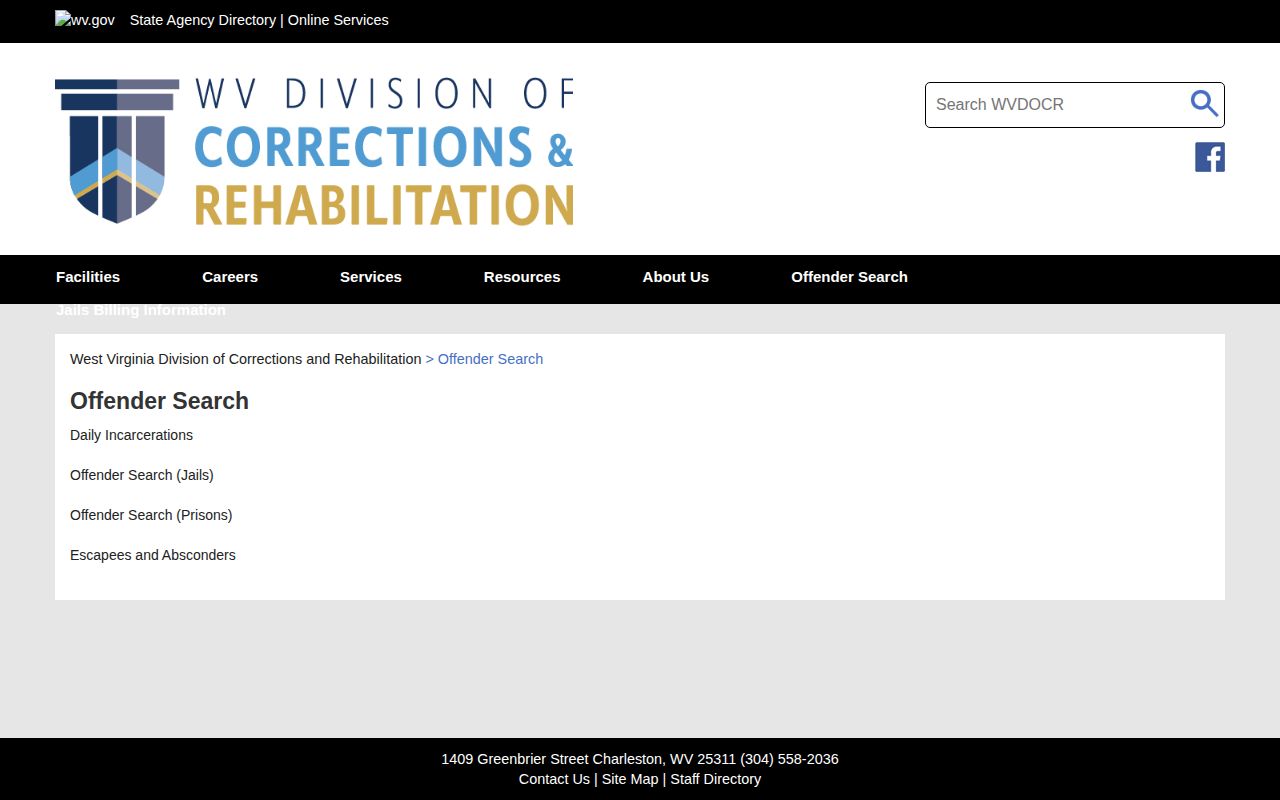
The WVDCR landing page below shows the official routes that separate regional-jail custody from prison custody. That split is crucial for a Clay case because Central Regional Jail serves the county while WVDCR also manages prison sentences.
A search result is the lead, not the whole calculation. Policy Directive 142.00 identifies public date and time fields that may include parole eligibility, full-term expiration, projected minimum discharge, good-time allowance, street time, jail credit, mandatory release, and actual release. Request the public portions when the screen does not explain the arithmetic.
| Field | What it can establish | What it cannot establish alone |
|---|---|---|
| Offender number | Links the person to the WVDCR file | Present custody or release |
| Location or status | The agency's reported state at query time | A complete transfer history |
| Parole eligibility | Possible consideration date | A right to leave custody |
| MDD or final release date | Current sentence calculation | A guaranteed gate time |
| Past release entry | A reported completed event | Whether another authority took custody |
Clay Dates Reject the 85% Shortcut
There is no universal West Virginia rule requiring every WVDCR inmate to serve 85 percent of a sentence. That shortcut should not be applied to a Clay County projected release date. West Virginia uses offense-specific sentences, parole laws, statutory exclusions, good-time provisions, conditional or mandatory supervision, and the terms of the actual judgment. The sentence date and offense can also determine which version of a law governs.
The meaningful number is the person's own minimum-discharge or final-release calculation. WVDCR Policy 151.06 directs calculation with applicable jail credit, good time, and street credit and permits OIS date changes. Policy 151.07 documents the overall result on a time sheet. The court judgment supplies the sentence. Together they are far stronger than a web calculator or generic fraction.
Parole eligibility must remain separate. WV Code §62-12-13 can begin eligibility at the minimum term of an indeterminate sentence or one fourth of a definite term in many cases, but it contains many exceptions. Eligibility allows review. It does not compel the Board to release someone, and it is not the MDD.
Note: Use the exact WVDCR time sheet and sentencing order; do not estimate a Clay release date from a headline percentage.
Clay Good-Time Release Calculation
WV Code §15A-4-17 provides the ordinary state framework for commutation for good conduct. For an eligible adult, one day may be deducted for each day physically incarcerated, including qualifying presentence jail credit awarded by the sentencing court. Ordinary good time does not accrue while on parole or bond. Life sentences do not receive ordinary good time. Credits may be forfeited and restored through disciplinary processes.
The statute also allows limited additional credit under specified conditions and treats consecutive sentences as combined for good-time purposes. In a straightforward eligible sentence, one-for-one credit may support a reduction approaching one half. Even that cannot be applied by simple subtraction. Offense exclusions, statutory minimums, sentence dates, discipline, escape time, jail-credit findings, and concurrent or consecutive orders can change the result.
Some physical releases begin supervision rather than ending the full obligation. Section 15A-4-17 can reserve accumulated credit for a mandatory-supervision period in qualifying cases. WV Code §15A-4-17a also permits an eligible conditional-release plan before minimum expiration and treats the person as released on parole until that expiration. Therefore the gate date and final discharge date must be recorded separately.
Why Clay Release Dates Change
A WVDCR date can move when the facts or law applied to the time sheet change. Some changes shorten the calculation, while others extend it or change the destination. The public offender detail may lag the underlying work. A new date should be confirmed through a revised time sheet rather than inferred from a changed web result.
| Factor | Possible effect | Record to check |
|---|---|---|
| Jail credit correction | Moves the calculated date | Court order and WVDCR time sheet |
| Good-time loss or restoration | Extends or shortens the MDD | Disciplinary and time records |
| Sentence modification | Changes the term or credits | Amended judgment |
| Concurrent or consecutive ruling | Changes how terms combine | Sentencing orders and calculation |
| Detainer or hold | May change destination after WVDCR custody | Detainer and release checklist |
| Parole action | May permit conditional release after processing | Board decision and WVDCR release entry |
| Escape or dead time | Adds time not credited | Status history and revised time sheet |
A detainer is a request or legal basis for another authority to take or hold the person. Release from WVDCR to that authority is a transfer of custody, not a return to the community. Ask the release record to name the receiving agency.
Clay County Jail Sentence Dates
For a county-jail term, start with the written sentence, commitment date, and the court's jail-credit finding. Ask the Clay clerk for later amendments. Then ask WVDCR for the time record associated with Central Regional Jail and the public part of the release checklist. Do not subtract a general percentage from the maximum term.
The regional facility is physically in Braxton County, but a Clay arrest or sentence remains tied to the Clay case. Give both facts in a request. Include the person's full name, date of birth or offender number, approximate admission date, Clay as the arresting or sentencing county, and Central Regional Jail as the facility. Ask for the MDD or final release time sheet, revisions, and the later date and time of physical release.
A pretrial stay follows a different track. The court can authorize release, but the facility still must process identity, papers, detainers, notifications, property, and other required steps. The filing time of an order is not the physical exit timestamp. The completed WVDCR release checklist is the stronger record of the actual event.
Note: No official public gate time, weekend schedule, or holiday release rule was verified for Central Regional Jail.
Confirm a Clay Release Event
A calculated date becomes reliable historic evidence only after it is matched to the facility record. WVDCR Policy Directive 457.02 identifies a release checklist with the offender, OID, confirmed date, release type, staff signoffs, release authority, detainer action, and receiving custody where applicable. Protected parts may be redacted, but the nonexempt event fields can distinguish community release from transfer.
For a pending event, register for a VINELink release check and keep the confirmation. Treat the alert as an operational notice, then verify it with WVDCR or the court. A Board grant may require intake steps before release, while a court order may precede facility processing. When the dates conflict, ask WVDCR for the revised time sheet and exact physical-release entry.
Use West Virginia FOIA with reasonable detail if the web result disappears. Request electronic copies of the public time sheet, release order, status history, and release checklist. Under WV Code §29B-1-3, the custodian must act as soon as practicable and within the statute's response period, but that deadline is not a promise that every record will be delivered at once.